

A backend that works with any platform
WEEGLOO is a content management system (CMS) that takes on your service's backend. It stores data, accepts members, publishes, assigns permissions, and delivers what you have published to the screen. The screen your users see (whether a website or a mobile app) sits on top of it.
The key is that the screen and the backend are separate. So whether you build for the web, build an app, or run both does not change the backend. WEEGLOO does not care what kind of screen it is. The same backend attaches to any platform.
The backend stays the same even when the screen changes
Data, members, permissions, and delivery are the backend's job, not the screen's. Once they are in place, whether you draw on them from the web or from an app, you use the same thing.
So building a new screen does not mean rebuilding the backend. If you built an app first, the backend you need when you later add a web front end is already there. It is the same if you started with the web and then added an app. Adding a new screen comes down to one line to the agent that wired up that screen, "Integrate this with WEEGLOO," while the backend stays untouched.
Building is not where it ends
WEEGLOO does not stop at building the backend; it also takes on what running that service requires. Once you launch, the work continues: searching and filtering through accumulated content, categorizing it, commenting on it together, exporting it in several languages, and managing who can do what. You handle all of this from the content studio (the screen where you write and manage content) from the very start.
This is the strength of a backend that starts from a CMS. Handling large volumes of content reliably, managing publishing and versions, and dividing permissions in fine detail all become more necessary the longer a service runs. Whether the screen you build is web or app, building and operating carry on atop the same backend.
See it in an example
The Running Tracker Service shows both of these together. A phone app and a web page, two screens, attach side by side to a single WEEGLOO backend, and permissions and delivery are managed so that each signed-in person receives only their own records. Below is that service seen on the web. You see the same data unchanged in the phone app.
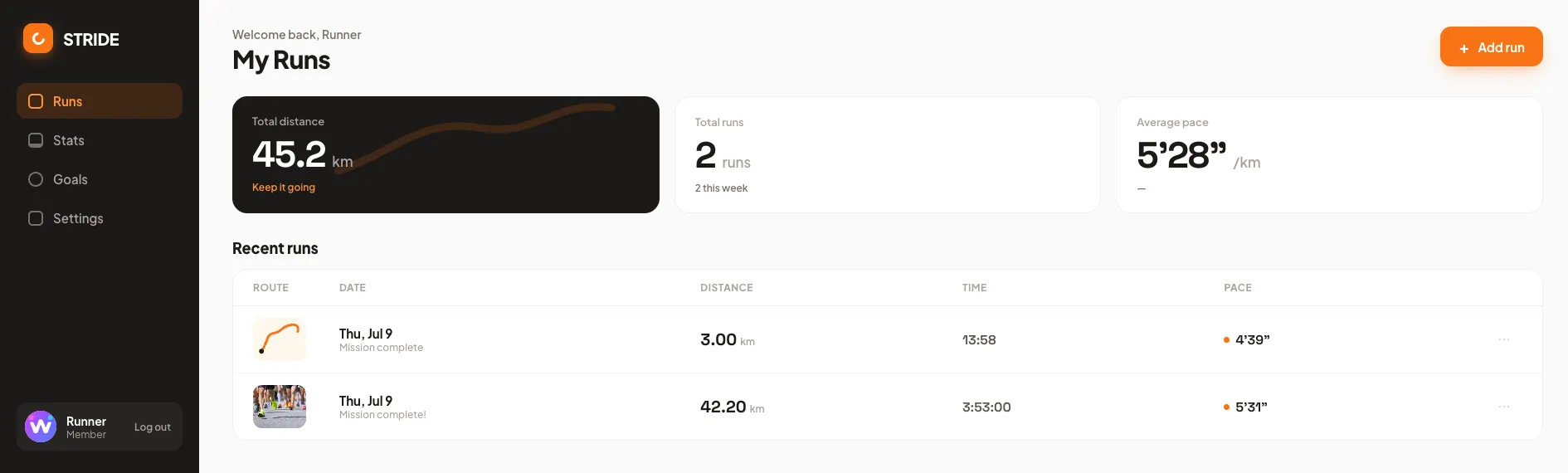
Adding the web on top of the backend you built while making the app means there is no new backend to build. For how this service is built and operated from start to finish, see Running Tracker Service.
What comes next
- What is WEEGLOO?: covers the full picture of what WEEGLOO is and why you would use it.
- Running Tracker Service: covers a complete, start-to-finish example of building and operating both a phone app and the web on a single backend.
- Integrate with one sentence: covers the flow of building all the features behind the screen at once with the single line "Integrate this with WEEGLOO".