

Expanding Further
Last updated: June 22, 2026
So far you have built a basic Tech Blog where you write posts and view them on the web. But real services rarely stop at storing and displaying data. They often integrate with external systems to broaden what they can do.
For example, you might want to detect when a new post is created or an existing post is edited, and automatically run a specific task in response. Or you might want to write a post in just one language and then auto-translate it into others to fill out multilingual content.
Receiving Events with Webhooks
WEEGLOO provides the Webhook feature for exactly this kind of expansion. A Webhook works by sending event information to a predefined external server whenever a change occurs on a specific resource. In other words, when an event such as the creation, update, or deletion of Content happens, a request carrying that information is automatically sent to the Web API you designate.
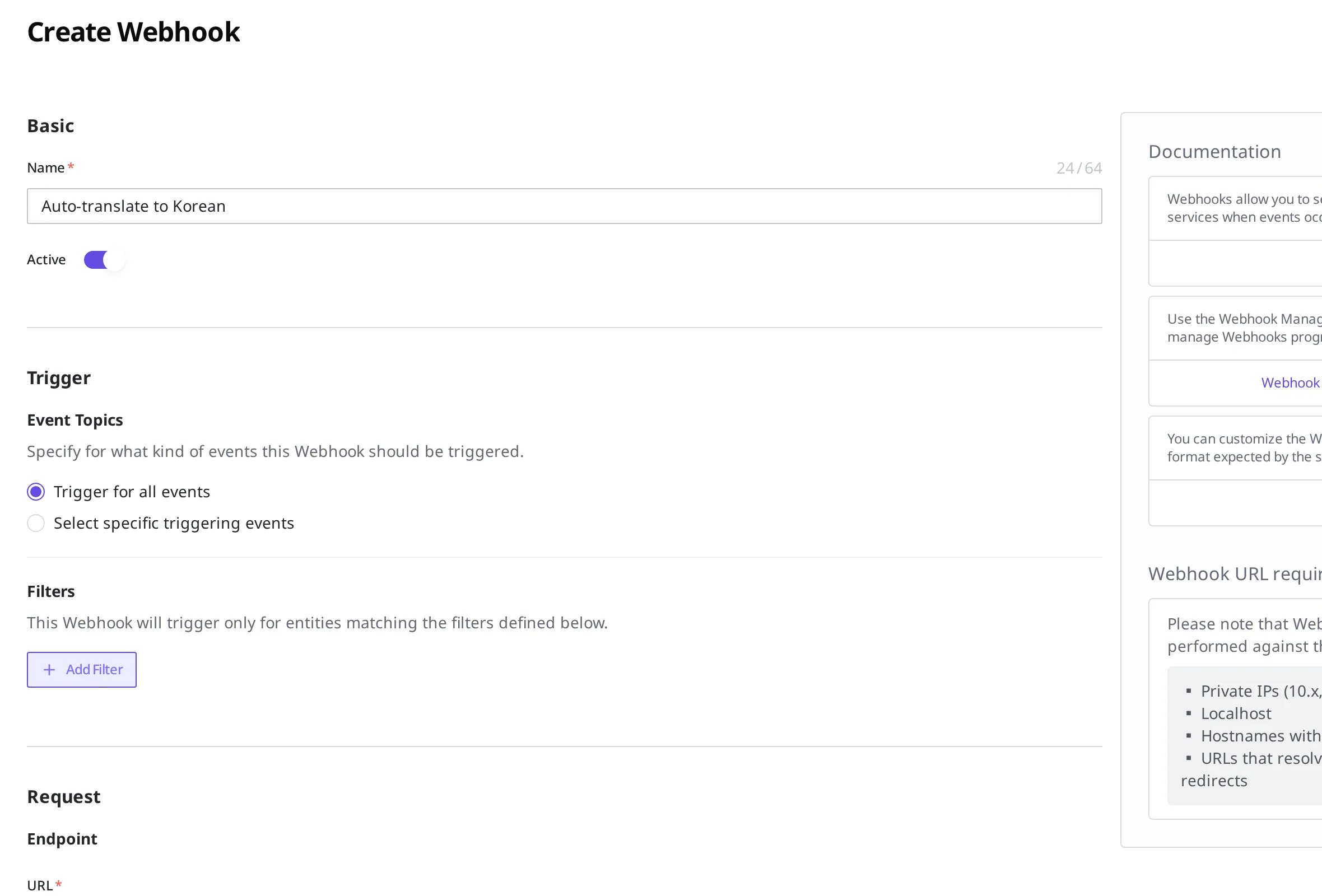
- In the left menu, click Webhooks and then click Create.
- Enter a name for the Webhook and the URL of the external server that will receive the events.
- Choose which events it should respond to (for example, Content creation or update) and save.
Expanding with Automatic Translation
With this feature you can set up a wide range of automations. At the moment a post is created or updated, you can receive the event through a Webhook and place a server (Handler) to process it and perform additional work.
As one example, consider a flow where you write a post only in English and then automatically translate it into another language.
- A Webhook sends the post creation or update event to the Handler.
- The Handler passes the received content to a translation system such as an LLM to render it in Korean.
- The translation result is written back into WEEGLOO through the CMA (the management API for creating and editing content).
This way a single post is automatically filled in with both English and Korean. The multilingual structure you saw earlier in Integrating with Your Service (values per Locale) is filled in automatically, without a person moving each value over by hand.
By combining Webhook and the API like this, you can extend WEEGLOO beyond a content store into a data hub connected to many systems. More advanced setups become possible, such as automated content processing, external service integration, and event-driven features.
For more details, see Webhook.
This brings us through the flow of building, collaborating on, and expanding a service with WEEGLOO. With this flow as a foundation, you can flexibly apply WEEGLOO to many different kinds of services.
- Using AI: Explore how to create content with AI and build and deploy a site.